How to Work with an Anion Gap Calculator for Acid base Differential Diagnosis
An anion gap calculator is more informative than a simple calculator when you need quick, reliable diagnostic interpretation of serum electrolytes. In practice, the anion gap helps clinicians analyze acid-base balance, check for metabolic acidosis, and narrow a broad differential diagnosis by identifying likely causes of unmeasured anions from disorders driven by primary bicarbonate loss or chloride retention. If used correctly, it becomes part of a broader diagnostic algorithm rather than a stand-alone number.
This guide explains how the anion gap formula works, how to interpret a normal anion gap versus an elevated anion gap, and how to account for hypoalbuminemia using albumin correction. It also demonstrates how to connect the result to real-world causes such as lactic acidosis, ketoacidosis, renal failure, renal tubular acidosis, and toxic alcohol ingestion.
What the Anion Gap Measures
The anion gap is a computed value obtained from common electrolytes on a basic metabolic panel. It estimates the difference between measured positively charged ions and measured negatively charged ions, helping clinicians infer the presence of unmeasured anions in the blood. As the body maintains tight acid-base balance through buffer systems and kidney function, shifts in the gap can suggest a significant metabolic derangement.
In the classic interpretation, sodium is compared against chloride and bicarbonate, which are the main contributors in routine chemistry testing. The gap shows the balance between these measured ions and other charged particles not directly reported, such as proteins, phosphate, sulfate, lactate, and organic acids. This is why the gap can uncover a hidden acid-base disorder even before the precise cause is known.
The test is often used as part of clinical assessment when a patient presents with low bicarbonate, altered mental status, unexplained tachypnea, or an abnormal metabolic profile. A single number does not establish the diagnosis, but it can quickly steer attention toward the right branch of the differential diagnosis.
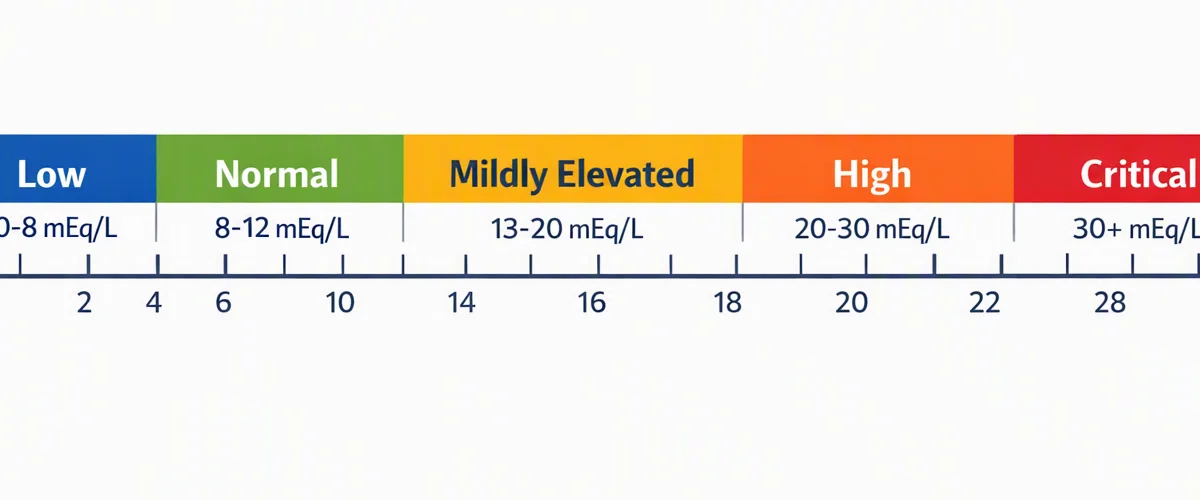
Anion Gap Calculation and Input Values
The basic anion gap equation is:
Anion gap = Sodium − (Chloride + Bicarbonate)
Some medical professionals use potassium in the calculation, notably in traditional textbooks or specific methods:
Anion gap = Sodium + Potassium − (Chloride + Bicarbonate)
Modern medical use emphasizes the sodium-based version because potassium is usually low relative to sodium and adds limited value to routine interpretation. Even so, an anion gap calculator may use either approach, so it is important to know which formula is being applied. Small differences in the equation can shift the number enough to affect clinical judgment.
Key inputs are drawn from the electrolyte panel or chemistry panel: sodium, chloride, and bicarbonate. In many cases, the calculator also asks for albumin because low protein levels can mask a clinically important elevation. Since serum albumin level strongly influences the baseline gap, a raw number without context can be misleading.
As an example, a patient with sodium 140, chloride 104, and bicarbonate 24 has an anion gap of 12. That value may be normal depending on the lab’s reference range, but the interpretation changes if the patient has severe hypoalbuminemia or evidence of metabolic acidosis. The calculation is only the starting point for result interpretation.
How to Interpret a Typical vs Increased Anion Gap
Assessment starts with the lab’s reference range, since typical readings differ a little by assay and institution. In general, a normal anion gap suggests that the bicarbonate decrease is being balanced by a rise in chloride, while an elevated anion gap indicates accumulation of unmeasured acids or their anions. Either pattern can indicate metabolic acidosis, but they suggest different etiologies.
A high anion gap metabolic acidosis usually means acid is being added to the body or retained because the kidneys cannot clear it effectively. Common causes include organic acids and toxins. By contrast, a normal anion gap metabolic acidosis is often a hyperchloremic process, where bicarbonate is lost and chloride rises to maintain electroneutrality.
Practical interpretation works best as a branching diagnostic algorithm:
- Normal anion gap: think bicarbonate loss or renal acid-handling problems.
- Elevated anion gap: think added acids, accumulation of acids, or toxin exposure.
- If the number seems unexpectedly normal, check albumin and consider anion gap correction.
It is also important to confirm whether the patient truly has metabolic acidosis. A low bicarbonate on a chemistry panel is not enough alone; an arterial blood gas can help clarify pH and respiratory compensation. This is especially valuable when mixed acid-base disorders are possible.
Corrected Anion Gap for Low Albumin
Albumin is a major not directly measured anion, so reduced albumin lowers the measured anion gap. That means a patient with hypoalbuminemia may have a deceptively regular or only slightly elevated result despite meaningful acidosis. This is why albumin correction matters in everyday interpretation.
The corrected anion gap modifies the measured value upward when serum albumin is below normal. Several correction methods are available, but a common clinical approach is to add a fixed amount for each gram per deciliter albumin is below Helpful hints normal. The exact factor may vary by institution, so the calculator should be used in line with local practice or its stated assumptions.
This anion gap correction is especially relevant in critically ill patients, patients with malnutrition, liver disease, chronic inflammation, or nephrotic states. In these settings, the raw number may underestimate the burden of unmeasured anions and therefore hide a true acid-base disorder.
Consider this clinical logic: a patient has low bicarbonate and a “normal” gap, but the serum albumin level is markedly reduced. After albumin correction, the gap becomes elevated, revealing a mixed picture or a hidden high-gap process. In other words, the corrected number can change the differential diagnosis and the speed of workup.
Clinical Differential of High Anion Gap Metabolic Acidosis
High anion gap metabolic acidosis happens when acids accumulate or are not cleared. In essence, bicarbonate is consumed while the resulting anions are not detected in the standard panel. This leads to a expanded gap and a structured differential.
Frequent causes include lactic acidosis, ketoacidosis, renal failure, and toxic alcohols. Each has typical clinical clues, but overlap is common, so the anion gap should be integrated with history, physical exam, and lab values.
- Lactic acidosis: commonly caused by hypoperfusion, sepsis, hypoxemia, or severe metabolic stress.
- Ketoacidosis: covers starvation ketosis, alcoholic ketosis, and diabetic ketoacidosis, which frequently presents with hyperglycemia, dehydration, and ketones.
- Renal failure: impaired acid excretion leads to retention of acids and progressive metabolic derangement.
- Toxic alcohol ingestion: including methanol or ethylene glycol, which can lead to severe high-gap acidosis and end-organ injury.
Within diabetic ketoacidosis, the gap is commonly greatly elevated because ketone bodies build up. In renal failure, the pattern may evolve with progressive retained acids and a drop in renal filtration. In cases of toxic alcohol intake, the anion gap can rise early, and the clinical picture may include osmolar gap changes, visual symptoms, neurologic decline, or kidney injury depending on the agent.
With an anion gap calculator in this context helps guide the next action in medical assessment: lactate measurement, ketone assessment, toxicology evaluation, or kidney function review. The number does not replace judgment, but it improves the differential diagnosis.
Diagnostic Overview of normal anion gap metabolic acidosis
A normal anion gap metabolic acidosis is often called hyperchloremic acidosis because chloride rises as bicarbonate falls. Here, the issue is usually not the addition of unmeasured acid, but rather alkali loss or impaired renal acid handling. The anion gap remains normal because chloride substitutes for the lost bicarbonate.
Key causes include diarrhea and renal tubular acidosis. Gastrointestinal bicarbonate loss is a classic mechanism in diarrhea, especially when losses are prolonged or severe. The kidneys may also fail to acidify urine properly in renal tubular acidosis, producing a chronic or recurrent normal-gap acidosis.
Other contributors to normal anion gap metabolic acidosis can include high-volume saline administration, certain medications, and tubular dysfunction, but the main clinical distinction remains the same: chloride increases as bicarbonate falls. This is why the serum chemistry pattern matters as much as the calculated number.
When evaluating a normal-gap pattern, ask whether the problem is a true loss of alkali. If the answer is yes, then alkali loss from the gut or kidney becomes central to the diagnostic workup. That makes the anion gap an efficient tool for directing the next branch of the acid-base differential diagnosis.
Typical Interpretation Errors and Medical Context
Even when a accurate result can mislead if the clinical context is ignored. One frequent issue is lab error, such as specimen contamination, transcription error, or a mismatched set of results. Before you deciding that a severe acid base problem exists, verify that the lab values are internally consistent and compatible with the patient’s symptoms.
Another important issue is overlooking albumin. If the protein concentration is low, the raw anion gap may downplay the true burden of unmeasured anions. This is why albumin correction should be taken into account in any patient with suspected metabolic acidosis and low albumin.
The delta gap is an important important concept. When the anion gap is elevated, the delta gap compares the rise in the gap to the fall in bicarbonate. This can help detect mixed acid-base disorders, such as simultaneous metabolic alkalosis or an additional normal-gap acidosis. In practice, the delta gap can show whether the patient’s metabolic profile is more complex than the first calculation suggests.
Additional common mistakes include using the improper reference range, failing to confirm pH on an arterial blood gas, and interpreting a single number without considering respiratory compensation. The most accurate results come from integrating the calculator output with a full clinical assessment and the broader picture of electrolyte imbalance and organ function.
When You Should Use an Anion Gap Calculator in Clinical Workflow
An anion gap calculator is most helpful early in the evaluation of suspected acid-base disorder. It fits naturally into a workflow that begins with a basic metabolic panel or electrolyte panel, then moves to an arterial blood gas when pH and compensation need clarification. This sequence supports efficient clinical decision support and more focused testing.
Use the calculator for low bicarbonate levels, when there is unexplained tachypnea or altered mental status, or if toxin exposure is a concern, sepsis, renal dysfunction, or ketoacidosis. It is also useful when reviewing serial labs because changes in the anion gap can reflect improvement or worsening in the underlying metabolic derangement.
In practical terms, the workflow often looks like this:
- Check the basic metabolic panel for sodium, chloride, and bicarbonate.
- Run the anion gap calculation using the calculator.
- Check albumin and follow corrected anion gap logic if needed.
- Use an arterial blood gas to confirm acidemia or alkalemia and assess compensation.
- Move to the appropriate differential diagnosis for high-gap or normal-gap causes.
This approach makes the calculator part of a larger clinical decision-making process rather than a standalone number generator. It helps clinicians move quickly from a chemistry abnormality to a meaningful explanation, especially in time-sensitive settings.
FAQ About Anion Gap Interpretation
What is an anion gap calculator used for?
An anion gap calculator is used to estimate the difference between measured cations and anions on a chemistry panel. Clinically, it helps recognize metabolic acidosis, guide acid-base differential diagnosis, and differentiate between high-gap and normal-gap causes of acid-base disorders. It is especially helpful when combined with albumin and arterial blood gas data.
How do you calculate the anion gap?
The most common anion gap formula is sodium minus the sum of chloride and bicarbonate: sodium − (chloride + bicarbonate). Some methods also include potassium, but the sodium-based formula is most commonly used. The values usually come from a basic metabolic panel or related electrolyte panel.
Why does a low albumin affect the anion gap?
Albumin is a primary unmeasured anion, so when hypoalbuminemia is present, the measured gap can appear lower than it truly is. That is why albumin correction is anion gap in chronic kidney disease important. A corrected anion gap more accurately reflects the real burden of unmeasured acids and improves diagnostic interpretation.
What leads to a high anion gap metabolic acidosis?
Common causes of high anion gap metabolic acidosis include lactic acidosis, ketoacidosis, diabetic ketoacidosis, renal failure, and toxic alcohol ingestion. These conditions elevate unmeasured acids or reduce acid clearance, increasing the gap and suggesting a significant metabolic problem.
Can a normal anion gap still occur with metabolic acidosis?
Yes. A patient can have normal anion gap metabolic acidosis, also called hyperchloremic acidosis. This pattern often occurs with diarrhea or renal tubular acidosis, where bicarbonate loss is matched by a rise in chloride. In that setting, the gap stays normal even though true acidosis is present.